Body Futurism
As society turns toward the body, a new politics of the flesh is on the brink of eruption.
Since 2023, this blog has been the home of my writing on social forms, health, and spirituality. My old blog, Subpixel Space, contains my writing from 2016-2024. For all of my work organized by theme, see the Archive page.
Subscribe to get updates when I publish, usually 2-3 times per year.
New here? Start with Body Futurism, Theory of Social Forms, or Prototyping Social Forms of Care to understand the themes that I'm writing about now.
As society turns toward the body, a new politics of the flesh is on the brink of eruption.
Social forms are the templates for ordered, formal, rule-based, and productive spaces of social practice.
I'm hosting an art exhibition on March 28th on the theme of Centers: modern monasteries, clinics, and community spaces.
Social innovators are experimenting with new social forms of care: centers, campuses, parlors, and practices.
Aggressive, egocentric, emu behavior is a social invariant. How have protocols evolved to handle it?
How Buddhism has transformed in order to address Western spiritual problems.
A speculative essay on "the talking cure."
What tools does Spengler offer for phenomenological analysis of culture?
The results of the first trial pop-up Concept Clinic at Edge Esmeralda.
The much-written-about "SoulCycle without the bike" is a thin practice with an even thinner mythology.
Don't Die, Choices in Healing, Thus Spoke Zarathustra, Enactive Psychiatry, The Normal and the Pathological.
The notion of “loneliness” is playing an increasingly prominent role in public health discussions around the world. What will happen when the loneliness propaganda is fully internalized?
Experts and enthusiasts from around the world have gathered on the island of Roatan to discuss longevity: the science and art of extending lifespan. I dropped into their two-month "pop-up city," Vitalia, to get a taste.
The terrain of American mental health is as vast and colorful as this country’s geography.
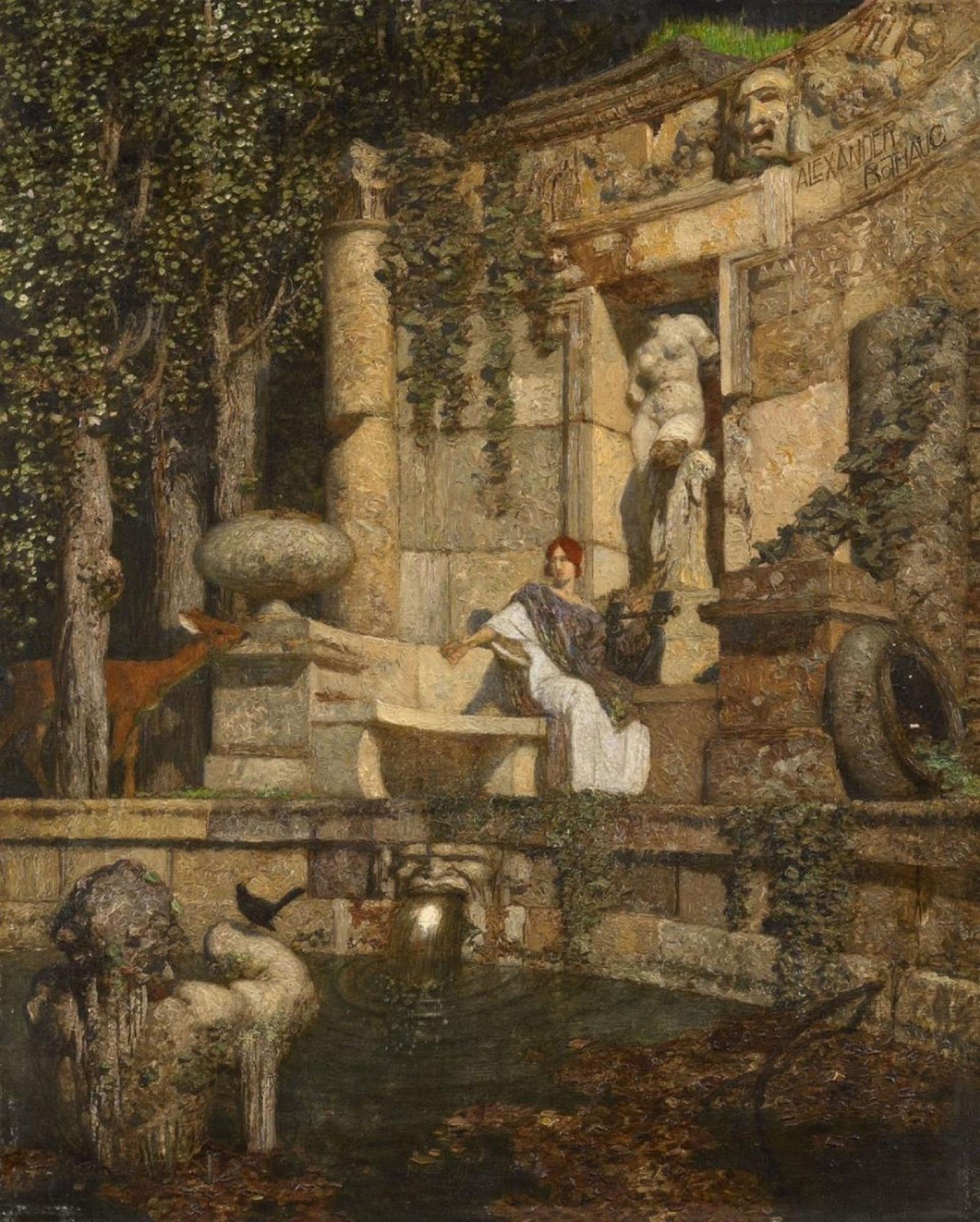
The painting is Poetry by Viennese painter Alexander Rothaug (1870–1946). It depicts a classical stone ruin in a forest, overgrown by ivy and grasses. On a stone bench sits a female figure with a lyre, likely Erato, the muse of lyric poetry. She extends her hand toward a deer and a blackbird, who appear enraptured by her presence. Despite the decaying ruins, the scene teems with life and motion.
I have chosen this emblem for the blog because it seems to me that the question of spirituality today is similar to the question of poetry: amidst the detritus of classical civilizations and the rummage room of modernity, how are new meaningful wholes to be made? The practice of poetry is a kind of magic, which creates new wholes out of nothing. And poetry is itself a technology of healing; to write poetry is to make oneself more whole.