Body Futurism
Settle down, settle down, look closely, and take a minute to settle in, beginning by imagining a plane of pure light at the top of your head—now sense as it passes its way down the tip of your scalp, down to your forehead, notice it rolling over the bridge of your nose now, very slowly, visualizing this plane of light making its way your past your throat—are you making subtle movements there as you read?—down to your shoulders, down to your arms, aware of your breathing as your chest fills and releases with air, noticing your diaphragm, scanning your whole body down further but slowly, slowly, now feeling the weight of your body on the chair, the points of contact between your clothes and skin, your feet, or the heft of that piece of glass and metal in your hand—can you feel it, can you notice the heat or cold of the air around you, and can you sense the newfound fascination with the body that permeates the airspace?
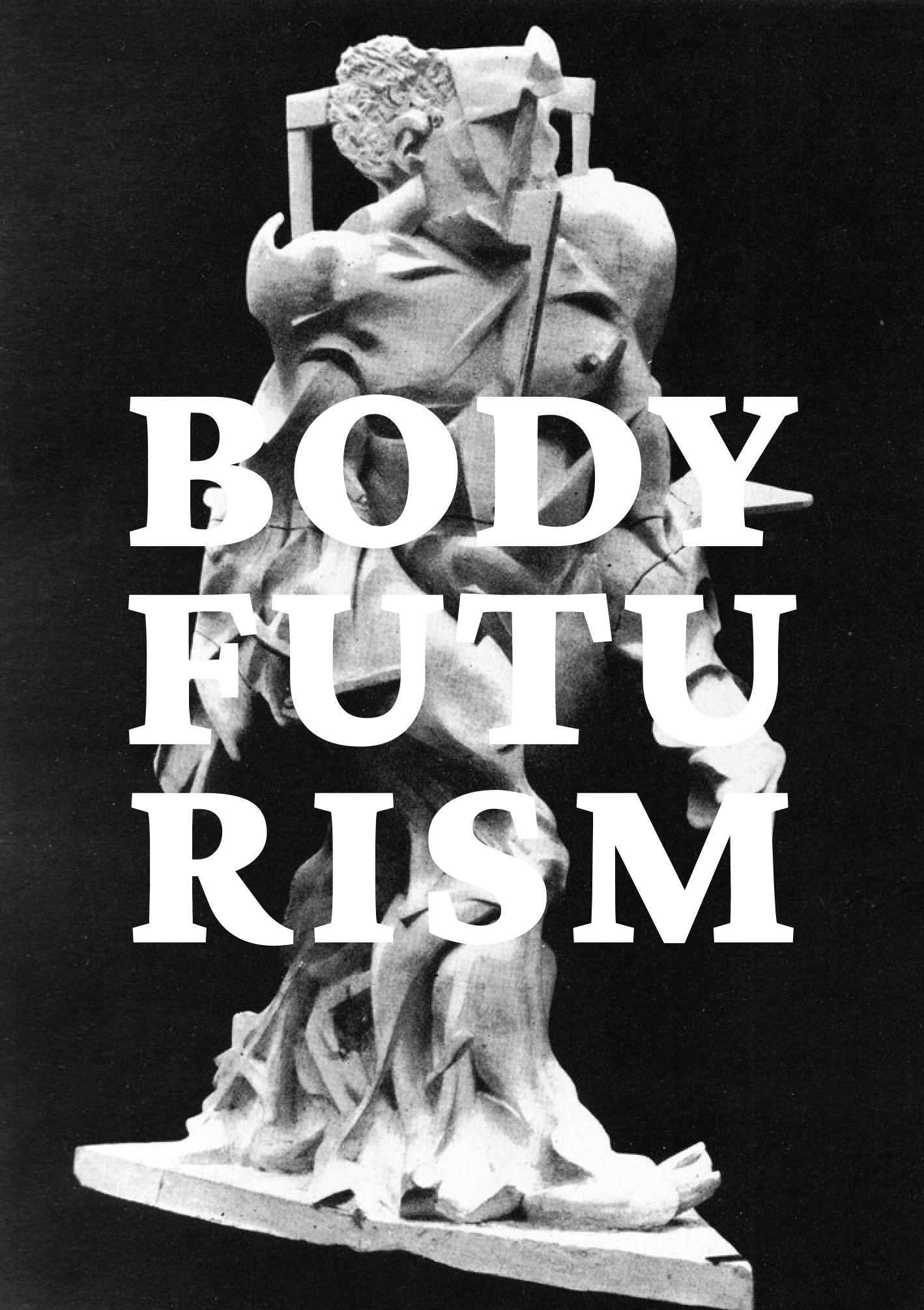
The spirit of Boccioni is alive and well in America. It was, after all, American industry and American cities, American modernity and an American century which inspired the Italian Futurists to refashion the statuesque image of Classical man into something dynamic, fluid, mechanical, technological. Now we Americans are at it again. Ancestral diets, crip cultures and diagnosed identities, health “protocols,” entrepreneurial interest in biomedicine, surrogacy, ubiquitous biometric measurement, and trauma discourse are all facets of the body’s increasing role in social thought. The new body futurism takes over from the now-tired futurism of software, but it is made of the same raw materials, mined from the California coast. Body futurism is the result of a republic turning its mind inward, of opponents of Cartesianism seizing the day in the academy, of technologists moving their attention from virtual spaces to physical places. In other words body futurism is overdetermined—so best get familiar. Settle in, settle in…
The Embodied Turn
Bodies are Eating the World
Up from the ground comes a great swell of bodies. Running, lifting, bathing, shaking down, thinning out and waking up, bodies have taken over popular culture. Huberman is the biggest podcaster in the nation. One in eight Americans have tried GLP-1s. Seed oil discourse has created a new physical purity drive. Van der Kolk’s The Body Keeps the Score has been at the top of The New York Times nonfiction bestseller list for 7 straight years, and healing practices like trauma release and somatic experiencing have earned mainstream adoption. These are just a few indications of the physicality of contemporary thought. The concerns of everyday Americans have turned to the embodied self.
Numerous factors paved the way for this embodied turn. The reaction against ensloppified, bot-infested social media is one. The bounceback from Covid-era work from home policies is another. Lifestyle brand burnout is a third crucial factor. In Life After Lifestyle I wrote that “conscious” consumerism as a substitute for legitimate community was bound to fail. I said we’re going from D2C brands to D2C practices. Well, everything now is some kind of run club, surf club, lifting club, walking club, hiking club, tea club, sauna club, among innumerable embodied associations. These microcrommunities leverage all of the tools of the D2C trade but put embodied practice in the front seat: dropshipped microbrands hosting meditation microretreats and bathhouse microevents; social media microinfluencers starting microacademies espousing the benefits of nervous system regulation and emotional literacy. Each will sell you a hat.
The embodied turn is much more than a trend in the marketplace of ideas. Body stuff is the moral source of what is fashionable, even when the fashions themselves are competing. Paleo warriors wolfing down steak and eggs and Ray Peatheads on a carrot salad and ice cream diet are both capable of earnest moral posturing—that is the point. Anything that captures the popular imagination today, whether scientific or spiritual, unfailingly draws from the realm of embodied practice. The network ideologies that matter are the ones that promote diets, mindfulness and prayer practices, biometric monitoring systems, and health “protocols.” These lived activities do what products never could: fulfill the moral premise of a lifestyle through embodied practice.
This body movement is being worked out across every segment of society. From policymakers to physical therapists, from the pulsating rhythms of ecstatic dancers to the Promethean efforts of tech entrepreneurs to extend life, everybody seems to have their own vision for the future of the body. Down some paths lie body-based technocratic control, astroturfed protocols of self-regimentation. Down others lie genuine liberation through true body awareness.
Kinesthetic Media
The vast adoption of kinesthetic social media in TikTok and Reels makes the newfound focus on the body a permanent societal shift. Every form of media takes a human faculty and extends it into the public domain. What the TikTok media format does is turn body practices into remixable, forkable content. Twitter is the marketplace of ideas where the intelligentsia debate diets; TikTok is the battlefield where body practices clash, evolve, and are tweaked to gain maximum adoption.
Scroll through a dozen thirty-second clips and you’ll see the embodied turn in action. People are breathing, they’re tapping, they’re shaking, they’re stretching to release trauma. Just a few decades ago, many of these body practices were the exclusive knowledge of mind-body therapists in hippie hotspots. Now the best of them are being traded around the noosphere, with plenty of money to be made by the enterprising healer-influencer. With the wheat comes the chaff, however. For every person who discovers yoga nidra or trauma release exercises is another who psyches themself into thinking they have Tourettes and then cures themself next month.
These phenomena were foreshadowed by teens doing weird dance trends and stealing cars. If a silly jingle can induce individuals to grand larceny, what are the political implications of TikTok’s influence over bodily life? We have already seen what Twitter did for social discourse: proliferate a hundred thousand bizarre micro-ideological strains and make them resistant to the antibiotics of institutional authority. TikTok, Reels, and YouTube are now doing the same for the social body. Watch Ballerina Farms to learn how to embody the tradwife. Subscribe to Back From the Borderline to learn occult meditations. Bodies are online, and they want your attention.
The Charismatic Economy
“Attention is all you need”—the name of the whitepaper that inagurated the current era of transformer models—is a perfect catchphrase for the transition to a pure attention economy where bodies matter most. AI researchers in San Francisco have all started GLP-1s and weightlifting routines, having convinced each other that physique will be the final competitive edge after AI takes all the white collar jobs. If their conclusion is excessive, the premise is correct. We have already entered an economy of charisma which grants status to various kinds of extreme physicality or virtuosity.
The combination of severely curtailed career mobility and the mainstreaming of gambling have created an economic environment characterized by grift. The biggest winners are naturally those who exude charisma and prowess. Charisma has long been the dominant mode in social media, but athleticism is now rewarded more than ever. Jake and Logan Paul pivoted into boxing; IShowSpeed does exhibition races; philosophy YouTuber Jonathan Bi lectures from exotic locations wearing open linen shirts that reveal how fit he is. Less and less, influencers are talking heads. More and more it is the bodies doing the talking. Only from this perspective can the preoccupation with testosterone levels, jaw angles, and height maximizing be understood. Men are mewing and women are getting botox at 30 instead of 50 because it is perceived as an economic necessity to appear hot online. Needless to say the logic of “body as asset” is made quite explicit in OnlyFans.
Even the wealthy have to play along with the charismatic economy. For some years the high status thing to do has been to start a company; now all the founders want to be longevity influencers too. The same utopian fervor once reserved for distributed systems is being used to construct ideologies of the body.
Bio-Utopianism
Software Utopianism
The utopian fantasies of the past three decades were shaped profoundly by software. The cypherpunk and cryptoanarchist movements of the 90s laid out cryptography-based visions of the future: digital nations without states, anonymous peer-to-peer exchange, effortless information flow. Then the 2000s saw the rise of social media, hailed as a technology that would enable the spread of open societies. In the 2010s cryptocurrencies launched a new wave of cryptoidealism, pumping narratives of global coordination, private money, and a world computer poised to disintermediate legacy institutions. In all these variations the software utopia is one accessed through a screen.
In the late part of this cycle, Silicon Valley thought leadership commingled breathless cybertopian stylistics with business models, fashioning concepts like the sharing economy, the gig economy, and the ownership economy. Geeks have always conflated operating systems and social systems—and rightly so. But in a classic medium-message mixup, every technology soon became a disembodied “space” of utopian thought. On Twitter, where these narratives thrive, we had the “crypto space,” the “AI space,” the “DTC space,” the “biotech space” and furthermore niche “spaces.” Each “space” encapsulated business model, people, technologies, the discourse, and most importantly, a promised social vision.
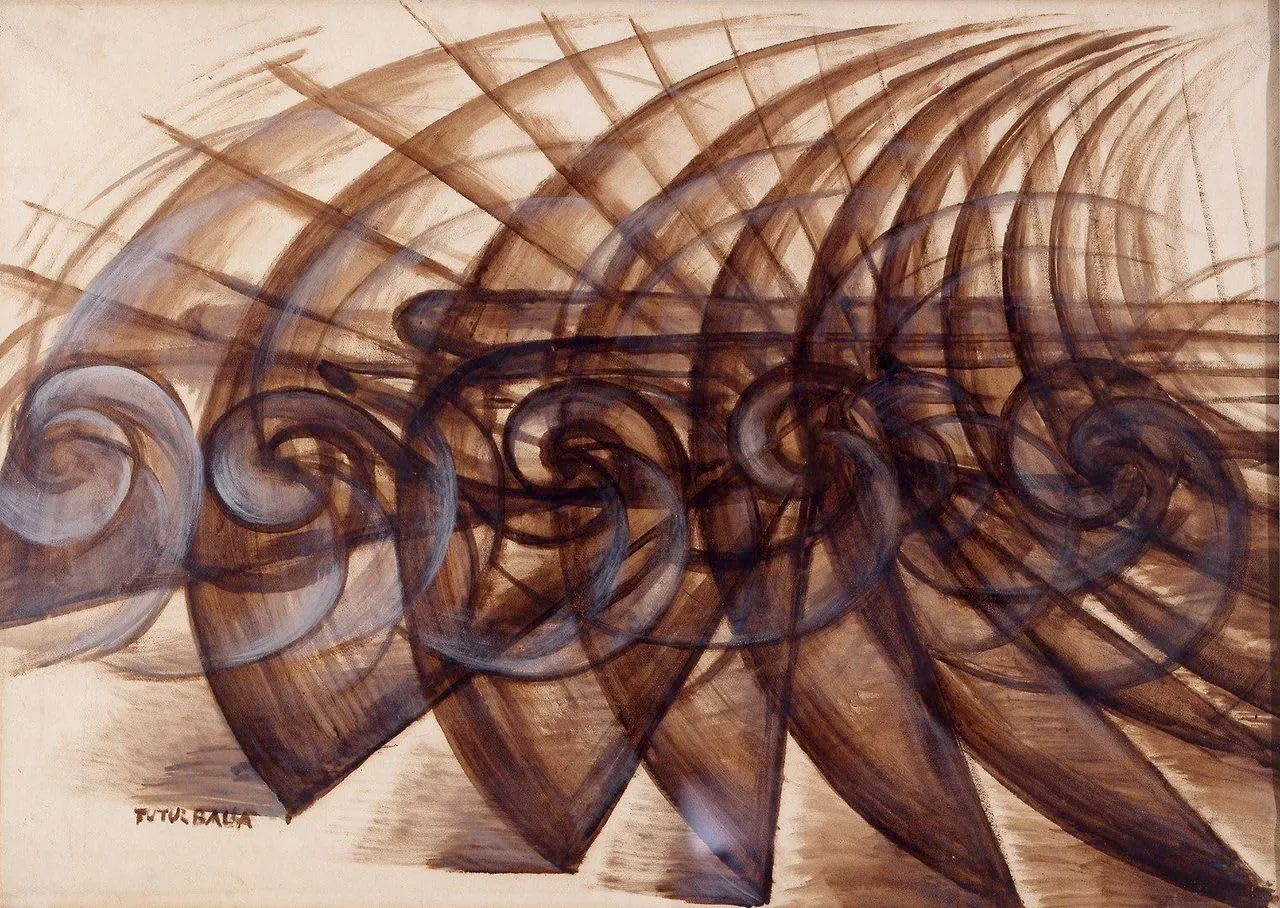
The relationship of the source technology to the “space” is that of the machine to the Futurist artwork. Boccioni’s Unique Forms of Continuity in Space or Balla’s Speed of a Motorcycle transform industrial machinery and automobiles into dynamic sculptural forms of amplified speed, power, and scale. Today’s technologists do the same when they base social-utopian imaginaries on machinic concepts. Simple concepts like digital cash transfers and business process automation become software-based parallel societies with their own economic systems and AI faiths.
The Collapse of Cloud Optimism
But over the last few years, these disembodied cloud utopias have slowly begun to evaporate. Software has not delivered on its fantastical premises, turning formerly bright-eyed millennials into technopessimistic doomers. In the wake of the techlash, what remain of the software futurists have consolidated around “effective acceleration;” only the promise of an AI god still holds hope for software utopians.
The surest sign of software exhaustion is that tech positivism is in the process of escaping itself into a variety of other domains. You no longer need to work “in tech” to hold the cultural positions of tech workers. Now there are life scientists, housing lobbyists, warmongers, and energy policy advocates who all take the technoprogressive stance. Climate thinking is moving away from limiting consumption and towards “energy abundance.” An identical move is underway in biomedicine with the transition from the ethos of “harm reduction” to the ethos of “life extension.”
But very few grasp the most vital point of this moment. Whether in ignoring the role of violence in maintaining the state or “memeing things into the discourse” as a worldbuilding strategy, the futurist tendencies of recent decades made little room for the physical person. With the fall of software comes the return of the repressed—the body itself.
Embodied Ideologies
Builders have become bodybuilders. Gray market peptides and gene therapies have replaced Soylent. The muscle tee and chain has replaced Zuck’s famous hoodie, and the office cold plunge has replaced the office beanbag couch. Grinders and quantified self, once fringe subcultures of Silicon Valley enthusiasts, have now been mainstreamed and productized by Whoop Bands, Apple Watches, and Eight Sleep mattresses. Meanwhile the rhetoric of body augmentation has become far more radical. Longevity, immortality, consciousness hacking, advanced meditative states, direct gnosis, enhanced Olympics, and designer babies are the relevant supermeme complexes. The human body itself is the new site of utopian technosocial visions.
For the latest crop of techno-Buddhists, the future is a world of supercompassionate meditators, operationalizing stream entry and scaling lovingkindness practice. The gene editors start by saying you can fix your kid's hereditary diseases in utero, and end up espousing a world of kid geniuses vibecoding their first company. Bryan Johnson’s DON’T DIE movement envisions a health-tracking longevity religion with an eschatology to rival the most fantastical software reveries: humanity’s rebuttal to AI is its bare survival into an ever-extending horizon.
Full-body biomonitoring is far out, but you can order Blueprint olive oil and stick a glucose tracker in your arm today. In comparison with the disembodied ideologies of social media worldbuilding, these imaginaries are grounded in fully corporeal interventions. Swap blockchains and transformer models for Pilates and peptides. The platform is different; the style of utopian extrapolation is the same. But body imaginaries are not just believed, they are physically lived.
Protocolism
If anything exemplifies the shift from the software to the body it is the word “protocol,” which has migrated from describing technical standards to signifying body practices. The new health protocols are the modernist architecture of kinesthetic behavior and the native social form of body futurism. Protocols for diet, breathwork, bodybuilding, and supplementation are open source rulesets. Vitamins, coaching, apps, and classes commercialize their implementation. Apple Health and Whoop provide the substrate for various influencer-led protocol schemas. These branded body practices are becoming hypercompetitive as health tech companies scramble for data on muscle movement, cardiovascular systems, and the content of dreams.
Weight Watchers, arguably the ancestor of contemporary health protocols, had already incorporated rigorous self-surveillance and social participation. Today’s protocols function similarly, while automating data collection via wearables and adding competitive social media layers (e.g. “Sleep Score”). Open source communities for protocols such as 75 Hard congregate on Reddit and sometimes on proprietary apps. Here we see an important feature of protocols: inasmuch as they are tightly scripted scopes of action, they are also participatory institutions that connect bodies through regulation.
Formally speaking then, the protocol is an embodied version of the e-ideology, composed of a charismatic influencer, a social media mind virus, and a fruiting body—a type of guy. While most of them seem to have an instrumental character, the moral is always embedded in the muscle fiber. Whether it’s ancestral diets or Huberman’s sleep schedule, there is a normative message in all of these prescriptions.
You have heard of protocols, but you need to understand protocolism. It is the format of social control suited to a world enchanted by body futurism. For the social elite, the old disciplinary institutions have loosened their grip, making way for a society based on location independence, remote work, flexible romantic arrangements, easy credit, wellness services, and other apparent freedoms. But these “self-chosen” protocols require constant self-monitoring and self-regulation.
Human Potential 2.0
With the rise of these embodied ideologies and networked faiths, one might venture that the 70s are coming back. What’s really happening is the Human Potential movement out of Esalen Institute all those years ago is finally fruiting into its full form.
The Human Potential movement applied California fronteirism to the human body itself—an evolutionary mysticism. Combining Romantic self-expression with the tools of science and that peculiar American taste for perfectionism, it aimed to access through mystical experience whatever latent capacities are dormant in man. Human Potential was obsessed with psychical research, with mind-opening drugs, with peak experiences, with the idea that we use only 10% of the neurons in our brain.
We now hear echoes of the same in today’s body optimization movements, although technologies that augment our natural capacities play a bigger role. Thus we have an ultrasound headband to induce lucid dreams and unlock unheard of qualia, ultrarigorous diet protocols to maximize mitochondrial biogenesis, and artificially ultraintelligent meditation instructions to create a society of sages. Both then and now, the goal of human potential is to create the superhuman.
Everything happening now is downstream of Esalen in some way. Not only the superhumanism and the ayahuasca retreats in Marin County and Byron Bay, but also the flush of unconventional social healing spaces that remix Esalen’s core propositions: mixed modality social sauna spaces in Toronto, Christian churches converted for pantheistic worship in Berlin, and community acupuncture clinics in Maine. Even the exploding popularity of somatic therapies can be traced to the Human Potential movement. Rolfers, Qi Gongers, Tantrikas, and mind-body practitioners of all stripes traveled through Esalen in the 60s and 70s. New schools of body-thought were born at Big Sur, and these practitioners settled the West, sowing the seeds of an alternative American folk religion.
Today what they planted is taking root in Texas, sprouting vigorously through the sidewalk cracks of New York, growing alien blooms in the dry California air, and blossoming across the vast plains of social media. From the superhuman bodies of dreaming technologists to the mythopoetic bodies of the new shamans, bodies across America are coming alive.
Now we have thoroughly surveyed the terrain and visited the many varieties of embodiment at play in this uncertain moment. What remains is the question of what kind of body politics can emerge from this contested ground.
Body Politics
Social Sickness
New understandings of the personal body always lead to new ideas of the social body—and vice versa. The medieval body politic was based on an anatomy of limbs, the head, the torso, and feet symbolically justifying the social hierarchy of king, nobles, and peasantry. Today’s embodied ideologies, sciences, and protocols likewise foreshadow its politics and its political bodies.
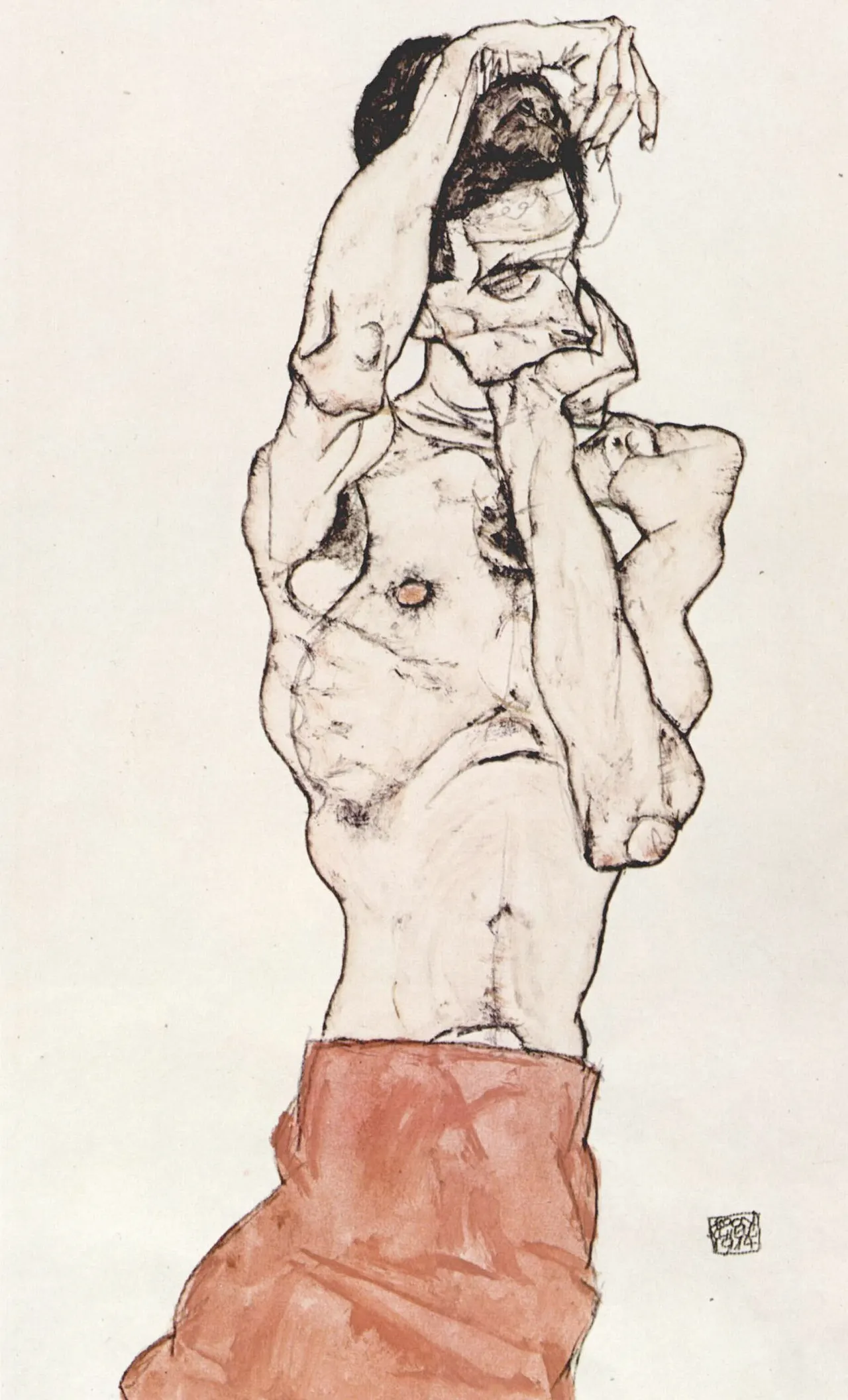
To make one example, the political dimensions of the embodied turn is blatantly visible in the current vogue for the pathological. Body politics is the politics of a society convinced of its own sickness. The technopessimism, gerontocracy, and senile nostalgia-mongering of the 2010s had already fostered a general sense of dis-ease. Now that very same ressentiment has found a home in numerous embodied maladies: the loneliness epidemic, the toxic food system, the hormonal dysregulation, the microplastics, the neurotic fixation on declining sperm counts, declining sex rates, declining everything. An emaciated social body reminiscient of Egon Schiele’s degenerate fin-de-siècle self-portraits.
All this social sickness, hypochondriac or real, contributes to the atmosphere of political decline and the prevailing sense that America or even Western civilization itself is ending. Disability is not merely a metaphor here. Public administration has gone defunct in reality, as the embarrassing mishandling of Covid and chaotic policies of Trump demonstrate. Despite the attempts of very online people to counter the feeling of looming crisis with utopian what-if thinking and institutional worldbuilding, software-based political praxis—whether “memeing things into the discourse” or the Right’s predictable embrace of clicktivism and cancel culture—is totally impotent. Grand narrative worldbuilding like “progress studies” no longer seems possible now that Twitter has turned into Elon’s personal propaganda engine. “New institutions” never arose.
Decomposition
Some who preach the decline of the West have found their prophet in historian Oswald Spengler, a thinker who himself likens culture to biology. According to Spengler, a culture in its old age becomes a civilization like ours: rational, rigid, “megalopolitan,” bureaucratized, petrified, managerial, de-spiritualized, refined, ornamental, wedded to the politics of “progress.” The uselessness of conventional statecraft and digital lobbying indicates a fundamental exhaustion of civilizational vitality.
If Spengler’s model holds any truth, then the decay of our institutions and the protocolish virtualization of selfhood are symptoms of a greater life cycle. An aging body breaks down and decomposes.
But things grow from rot.
The demise of our political and social organs is a necessary prelude to societal renewal. I believe that this is what is happening now: a literal decomposition of our tired political bodies, our geriatric institutional bodies, our abstracted social media bodies, a decomposition back into firm, energetic, sensual individual bodies.
This is not Waldenponding, nor atomization, nor is it the mistake Esalen made when it abandoned ‘60s radical politics for a purely interior spirituality. The body is not a retreat from political but its basic political unit, the raw material of nerve and flesh the foundation for new forms of communion. Spinoza saw this potential when he said: we do not even know what a body can do.
The Enlightenment of the Body
Bodies do things when not encumbered with institutional fetters. Those bodies are immobilized, restless, desperate for movement. If institutions no longer serve us, we can only turn to local forms of self-sufficiency—that is, new bodily arrangements.
Bodies are the foundation of what is real and of relationships to one another. At the core of every social form—every form of art, architecture, politics, and music, every run club and council meeting and dinner party—is simply an arrangement of bodies. Bodies moving in space, sensing each other, touching, exploring from first principles: what is actually good for this body? What social forms heal me? Repair me? In 1670 Spinoza proposed an ethics derived from bodily interactions: that joy and goodness arises when bodies compound together and increase each other's power, and sadness when they decompose each other. In this he was more farsighted than most philosophers. These very same body sensations are a key to the source of cultural vitalization.
This is a different use of the body than the homogenizing protocols and futurisms of self-chosen control. It is attunement to the mikrokosmos of felt experience, a phenomenological intuition that is the physical correlate of what is called “wisdom.” Capacities for resolving disputes in “satisfying” ways, handling conflict with grace, holding integrity in challenging moments, maintaining strength in political action—all these capacities are a physiological sensitivity.
The greatest potential of body futurism is just this—an enlightenment of the body. But for this enlightenment to unfold, the decomposition of social bodies into individual bodies must continue. The more fully one inhabits the senses, the more obvious becomes the extractive and domineering tendencies of defective institutions. Bodily autonomy arises as the natural counter. For when we return to the body, when we return to sheer sensation, it is possible to find what brings us joy, what compounds our power and assists us in becoming more free. And this freedom, this power, this joy is not to be found in solitude but in the joining of bodies.
A new politics based on the possibilities of the enlightened body is on the brink of eruption.
Enlightened Social Forms
The enlightened body asks: what arrangements of bodies, what patterns of interaction, what social architectures stoke within us a shared vitality?
These questions point to what is yet-unfelt by man: enlightened social architectures, grounded in the wisdom of the body. Phenomenological insight does not stop with the self but extends to socially complex domains. Christopher Alexander worked out how to create architecture from these foundations. Restorative justice procedures reconcile broken social contracts on similar principles. Call these new vernaculars—embodied languages of relationship and community that emerge from shared somatic experience. Or call new social forms—the physical and cultural structures that shape how bodies come together and interact. You may find cacao ceremonies and ecstatic dances distasteful, but these are fundamentally the same kind of innovation as mommy walking groups and warehouse raves.
A word to the wise. The bodies that can create these new social forms are not the battling, emotionalized, vibrating, explosive bodies exalted by the Italian futurists. They are not the heroic, athletic, enthusiastic, homogenous bodies introduced by German National Socialism. Those are the bodily programs of fascism, which failed not just militarily and morally but even productively—producing only a political dead end.
These bodies are the warm and sweating bodies, the liquidly sobbing bodies, the bodies of lovers, bodies with bruised feet planted half in the earth, turbulent, fleshy, sensual, eating, drinking and breeding bodies, black limbed and white limbed bodies, at home on the range bodies, at home on the pounding asphalt bodies, bodies of every hue and caste, bodies of every rank and religion, these are the democratic bodies, these are the New American Bodies.
You and Your Body
Body Relations
That is why you, you and your body, the very thighs you’re sitting on, those very lungs you’re breathing with, the very eyes you’re reading with, the very hand you’re gripping with, you and your body are the material, the resource at stake in this embodied turn.
You have to sensitize yourself to joyous affect, to avoid the awful passions of hatred and remorse. Protocolism and parasociality foster remorse against the body and everything that emanates from it. This is a poisonous disintermediation of our relations with one another. Rather than making ideological questions into proxy battlefields for our embodied, relational desires, we have to learn to build community out of our experience.
To enlighten the body is to immerse in practices that sensitize your physical perception to these relations—whether focusing or somatic experiencing or Hakomi or conscious sexuality or contact improv or sound bathing or hot and cold exposure. Do not take these on as a form of wellness or “self-care” but as experiential learning.
Mutual relations of joyous nature between bodies is the first principle of a new futurism: the futurism of your body. It would be wrong to construe this as navel gazing. Spinoza saw joyous relations between bodies as the foundation of the good. Christ taught universal love between men. It is only in a society based on harmonious relations between and among people, and from the working-out of harmonious body politics into more elaborate forms, that new social bodies can grow.
Become a Body
So to be a body futurist, you have to become a body first and foremost. You must become intimately aware of the most basic phenomenological sensations. You have to know:
What is the sense I get from the air around me right now?
What is it like to be near to whoever I am sitting next to? Can I feel their presence, right now?
What is my experience of this space? This architecture? This social scene?
Was this interaction successful? Did it make me feel nourished, or enriched? Did I feel connected? Or did I feel blocked, stultified, threatened, or dominated in some way?
And what role did I have in how this interaction played out?
Did I carry myself at arms length? With distance, with rejection, with fear? Or with openness? With a yes in my heart? With love?
Body Futurism
Spengler wrote The Decline of the West. But I say that America is not the West but something new. The decomposition of our institutions into mere bodily acts and back again is the natural cycle of cultural death and rebirth. It is time to let the old die. The corpse of an immanent god is the placenta of a new cosmology.
There is nothing more important to the renewal of culture than the enlightenment of the body itself, the development of a new folk phenomenology, the mysticism and eroticism of the somatic in all its varieties and forms. The cultivation of deep phenomenological insight is the foundation of a new Idea of what life can be. This Idea is very nascent. But if you sit here, listen closely, settle in, feel your forehead, the bridge of your nose, your breathing chest, if you listen to your heart as it beats to you, if you hear what it whispers when you sit, when you stand, when you leave this place, when you meet another’s gaze, you can feel it, as through the gauze of a veil…
With especial gratitude to Solon, with whom I developed many of these ideas, and to Chris Beiser and Kate McAndrew for superior editing, I owe thanks to Kariina Altosaar, Luke Miles, Eriel Indigo, Paprika Xu, Matthew Burdette, Mati Engel, Jackson Dahl, Sam Wolf, Charlotte Meng, and Welf von Hören for encouragement and feedback. I have appropriated from Miya Perry and Edouard Urcades. Gracious thanks to Friends With Benefits for inviting me to speak on this topic at FWB Fest in 2024, and to Gray Area Festival for hosting a revised version in 2025.